

Whispering rooms, p.1
Whispering Rooms, page 1
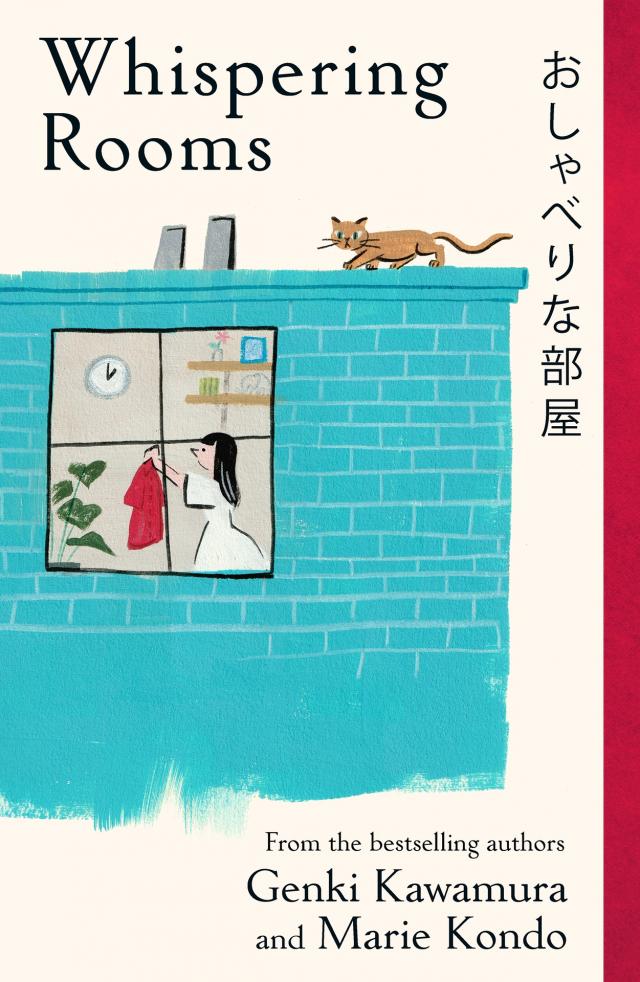


Whispering
Rooms
First published in 2022 in Japan by Chuokoron-Shinsa
First published in the UK in 2026 by LEAP
An imprint of Bonnier Books UK
5th Floor, HYLO, 105 Bunhill Row,
London, EC1Y 8LZ
Copyright © Genki Kawamura, Inc. and KonMari Media, Inc. 2026
English translation copyright © Cathy Hirano
Illustration copyright © Yosuke Omomo
All rights reserved.
No part of this publication may be reproduced, stored or transmitted in any form or by any means, electronic, mechanical, photocopying or otherwise, without the prior written permission of the publisher.
The right of Genki Kawamura and Marie Kondo to be identified as Authors of this work has been asserted by them in accordance with the Copyright, Designs and Patents Act, 1988.
A CIP catalogue record for this book is available from the British Library.
Paperback ISBN: 9781806170586
eBook ISBN: 9781806170593
Also available as an audiobook
1 3 5 7 9 10 8 6 4 2
Every reasonable effort has been made to trace copyright holders of material reproduced in this book, but if any have been inadvertently overlooked the publishers would be glad to hear from them.
The authorised representative in the EEA is
Bonnier Books UK (Ireland) Limited.
Registered office address: Block B, The Crescent Building
Northwood, Santry
Dublin 9, D09 C6X8, Ireland
compliance@bonnierbooks.ie
www.bonnierbooks.co.uk
Contents
Prologue
Room 1 The Whispering Wardrobe
Room 2 The Singing Study
Room 3 The Bickering Kitchen
Room 4 The Silent Childhood Bedroom
Room 5 The Chatty Little Box
Room 6 The Hoarder’s Noisy Trash
Room 7 Storytelling Photo Albums
Epilogue
Miko’s Tidying Tips
Prologue
I’ve got a secret I can’t tell anyone.
I can hear things talk.
Clothes, shoes, books, furniture – when I walk into a room, they all talk to me.
My job is helping people to tidy up their homes.
And here beside me is my tidying buddy: a chatty little box.
I suppose this must sound odd.
Maybe you’re wondering how tidying could be a job.
Or how someone can hear things talk.
Or what I mean when I say that my buddy is a box. But all these things are true.
I’ve tidied over a thousand homes. And each room in those homes overflowed with the memories and thoughts of the people who lived there and of the chatty things they owned.
Let me share with you a few of those stories.
Stories about some of the unusual rooms I’ve encountered.
ROOM 1
The Whispering Wardrobe
Mayuko Aizawa (age 49)
As I opened the door and stepped into the room, I was greeted by smells reminiscent of a crowded rummage sale – a mix of perfume, sanitiser spray and ingrained sweat. The room had once been a child’s room, but now cast-off clothes lay strewn across the floor like flotsam washed up on a beach.
I heard voices. Female voices. Hundreds of them. The clothes had all started talking at once.
Oh dear, is another new outfit going to join us?
Give me a break.
When will it be my turn to be worn?
Who’s that lady?
Those that still knew they were clothes could be heard more clearly, but the voices of the ‘used-to-be-clothes’ strewn in heaps about the room sounded more like screams than words.
It’s all right, I said inwardly. I’m here to help.
I tightened the red neckerchief I wore with my white dress, then placed my palms together in front of my chest and bowed deeply.
A voice came from behind me. ‘I bet you were shocked by the mess.’
I turned to see Mayuko Aizawa, my client. Her hands gripped the hem of her apron, which she wore over a frilly dress.
‘No, not at all,’ I said. ‘People usually hire me when they’ve got to the point that they don’t know what to do. Just thinking about how to tidy this up gives me a thrill.’ I smiled, but her eyes were fixed on my dress.
‘You’ll get that nice white dress dirty if you tidy in it.’
‘For me, tidying is like a sacred festival, so I want to look my best,’ I reassured her. ‘And besides, you’re the one who will do the actual tidying. I’m just here to help.’
I took a box from my shoulder bag and walked further into her room, taking care not to step on any of the clothes. Piles of underwear that hadn’t been folded littered the floor, dresses and coats were packed into the built-in wardrobe like sushi in a box, and T-shirts oozed from the dresser in the corner like filling in a double-decker hamburger.
As I walked around, anxious whispers spread through the room – the voices of clothes which only I could hear.
What’s going on?
I’ve got a bad feeling about this.
And like I said, who is she?
‘I couldn’t figure out where to start,’ Mayuko said as she followed timidly behind me. She ran a hand nervously along her neck where wrinkles were starting to show. ‘Do you think it’s really possible to tidy this up?’
‘Don’t worry. I’m sure you can do it.’ I smiled again.
The box, which I had tucked under my arm, cracked open his lid and said, There you go again, Miko. How can you say that so breezily when you know how much work it’s going to be? You’re always too optimistic.
‘It’ll be fine, you’ll see,’ I told him. This cheeky box with white and blue stripes is my tidying buddy. I call him Hako, which means ‘box’ in Japanese. He has been coming with me to my clients’ houses for the last four years or so, and as Miko & Hako, we make a pretty good team. How did I end up working with a box? Well, one of these days, I’ll tell you that story too, but right now it’s time to get to work!
I gave Mayuko her first mission. ‘Please take out all your clothes,’ I said.
Her eyes grew round. ‘All of them?’
‘Yes, all of them. And not just the ones in here. Bring everything you’ve got from every room and pile them in one place.’
The clothes began to clamour.
I was having such a nice deep sleep! How could you disturb me?
What’s she up to?
I bet she’s going to throw us all away!
Ignoring their voices, I began helping Mayuko as she removed the clothes from her wardrobe. Next, we tackled the dresser, emptying it of all the T-shirts, socks, hats, etc. Thirty minutes later there was a multicoloured mountain in the middle of the room.
‘Do you have any other clothes or is this everything?’ I asked.
‘I think that’s all.’
‘You’ll have to let go of any other clothes that turn up after this, so please make sure.’
‘Um … wait a moment. There might be a jacket hanging over the back of a chair in the dining room. Oh, and maybe something on the wall of my bedroom.’
She dashed out and quickly returned with a jacket and a coat. These two made it safely onto the pile of clothes.
‘Hold on a sec,’ she said. ‘There’s some stuff in the washing machine too.’
‘Clothes in the wash are okay,’ I said.
‘That’s a relief,’ she sighed.
But something didn’t seem quite right. Although she’d told me she lived in this apartment with her husband, I hadn’t seen any sign of him. ‘Is your husband going to join us?’ I asked.
‘He’s not interested in tidying,’ she said. ‘I don’t think he has any idea what’s here or even what kind of clothes I wear.’
Oh-oh. What’s all this? Don’t they get along? hissed Box, glancing at Mayuko’s forlorn expression.
‘Quiet,’ I whispered, shutting his mouth, or rather his lid, firmly.
Mayuko’s eyes were fixed on the pile in the middle of the room. ‘So here are all my clothes, but … what should I do next?’
I pulled back the curtains, which had been shut tight, and opened the window, letting in a flood of sunlight and the cool autumn breeze. Little birds darted across the mackerel sky. I turned to Mayuko, who was squinting up at the birds. ‘Start by thinking about your ideal lifestyle,’ I said, ‘the kind of life you’d like to lead.’
‘My ideal lifestyle …’
‘Visualise concretely how you want to spend your time in this space.’
‘I have no idea. I’ve never thought about it,’ she murmured. ‘Our kids have grown up now, so I just thought I’d live quietly with my husband. It never occurred to me there could be any other way. I can’t even begin to imagine.’ She paused and remained silent for a while.
I held her gaze and said, ‘You don’t have to come up with an answer right away. Just keep one thing in mind. You should keep things and discard things for the same reason: because that’s what makes you happy. That’s the most important point in tidying up.’
‘Because it makes me happy,’ she repeated, as if mulling this over. Although she looked puzzled, I could see that she was searching for her own answers.
I knelt down in front of the pile of clothes. ‘From here, you will choose what you want to keep and what you want to let go.’
‘How? ’
‘By asking yourself whether or not it sparks joy.’
‘Joy? But how will I know?’
‘Simple. By touching them. You’ll know if something gives you joy when you hold it in your hands.’
She looked a little anxious. Maybe she’d been expecting a more logical approach to tidying.
See. Just like I keep telling you, Hako grumbled from his hiding place under my arm. Now she thinks you’re weird too.
‘Shush!’ I whispered as I pulled him out.
You don’t seem to get it, but your approach seems kind of occult. I mean like seriously unscientific. No wonder people get suspicious.
‘Stop that!’ I said under my breath.
‘Is something wrong?’ Mayuko was looking at the box in my hands.
I whipped it behind my back and shook my head. ‘No. Nothing.’ She’d only think I was weirder if I told her I was talking to a box.
Clients often look bewildered when I tell them to choose what to keep based on whether it sparks joy. Some probably wonder if I’m a con artist. Even so, I always hope people will give it a try, at least once. Our bodies respond differently to each physical object we come in contact with. If we gather every item that falls into the same category in one spot, pick them up one at a time and ask whether it sparks joy, once we’re done, we’ll find we’re left with only the things we really need.
Instead of choosing what to throw away, we should choose what to keep. That’s the first step of tidying up: selecting only those things we feel will bring us joy and letting go of all the rest.
‘But I haven’t a clue where to start,’ Mayuko said.
I pointed to a pair of shorts which would be too cold for fall. ‘I recommend starting with off-season clothes,’ I said.
‘Why?’ Mayuko asked, picking up a thin blouse.
‘If you start with clothes you might wear right now, your joy sensor can’t function objectively. You’ll start thinking, “I just wore this yesterday”, or worry that you won’t have anything left to wear.’
‘I guess that makes sense.’
‘Also, the selection criterion for off-season clothes is clear. Just ask yourself if you’re eager to wear it when it comes back in season. As for those things you decide not to keep, remember to thank them for all their hard work before setting them aside. Why don’t you give it a try? Otherwise, you’ll never know if it really works or not!’
Maybe my little pep talk encouraged her. She reached tentatively towards the pile.
Try me on. You’ll look much younger, shouted a short skirt.
I’ll make you look pretty, exclaimed a blouse with a ribbon.
I can make you look slimmer, declared a dress with panels.
They’re all so full of themselves, aren’t they? complained Hako.
‘Don’t say that,’ I muttered.
You’ll look younger, prettier, slimmer. Although Mayuko couldn’t hear them, judging from what her clothes were saying, they all should have been bringing her joy. The stream of sweet words was unceasing, yet there wasn’t even a hint of joy in Mayuko’s expression as she held each one. She paused, staring at the dress clutched in her hands.
‘How about that one? Does it spark joy?’ I asked.
‘I’ve … never worn it,’ Mayuko murmured without answering my question.
I turned the dress over. Sure enough, the price tag was still on. ‘Whether you’ve worn it or not, if it doesn’t spark joy, let it go.’
‘But that’s such a waste!’
‘Even though you’d forgotten that you bought it?’
While helping people tidy, I often find clothes with the price tags still on or underwear still in the package. Although these articles are in their own home where they should feel comfortable, they look stiff and ill at ease. Clothes that haven’t graduated from being ‘store items’ will never be worn. Their owners may be convinced they’ll wear them ‘someday’, but months and years inevitably pass without that ever happening. To avoid this, I recommend taking them out of their packages and removing the tags as soon as you get home from the shop. The ritual of severing the umbilical cord connecting apparel to the store is essential if they are to leave behind their life as ‘shop items’ and begin life as members of their owner’s home.
I waded through a thicket of dresses and stumbled into a dense clump of shirts and blouses. Looking closely, I saw two that were exactly the same cut but different colours: one light blue and the other pink.
‘Mayuko,’ I said. ‘Why do you have two of these?’
‘I really liked the design so I bought the same shirt in a different colour.’ She reached out and took one in each hand.
The voice of the blue shirt sounded in my ears. Why don’t you do some work for a change?
What’re you talking about? retorted the pink shirt. Imagine yourself stuck at home all day like me, just waiting.
It’s your own fault! You’re not trying hard enough! If you want to be worn, you should pretty yourself up.
Don’t talk down to me! I’m not like you!
Mayuko, oblivious to their bickering, pondered the two shirts for a while, then decided to keep the blue one.
Goodbye then!
And good riddance!
Hako opened his lid timidly to take a peek. Ooh! Sibling spats are gruesome!
‘But considering the circumstances, I can understand how they feel,’ I said.
True. Looks like the blue one got worn a lot more than the pink. The blue one looks radiant because she was kept in good condition, while the pink one is still stuck in the package she came in.
I frequently come across this kind of sibling rivalry when I’m tidying clothes. Although many people buy shirts or trousers of the same cut in different colours, in most cases, they end up wearing only one of the pair. I feel sorry for the one that is never worn. Despite being so similar, it’s clear their sibling is the favourite.
Interestingly, this same trend occurs even when people buy identical garments of the exact same cut and colour. For some reason, one of the two is always chosen while the other is not. Squabbles between such identical twins can be spectacularly spiteful.
‘This doesn’t spark joy either … even though I loved it when I bought it.’ Mayuko was looking regretfully at a jacket she’d only worn a few times. It was a pink tweed with shiny black buttons. Despite having been one of her favourites, it had been stored at the bottom of a box. When clothes are piled in a box, the ones on the bottom have even less chance of being worn. Many times, clothes that people love when they first buy them end up forgotten in a pile once they stop sparking joy.
All I wanted was to be loved, the jacket said huskily.
Something prompted me to check the pockets. I slipped my hand in one and pulled out a ticket stub for a movie. A love story that had been a huge hit five years ago. It was hard to believe that creaseless stub was five years old.
‘I went with my husband,’ Mayuko whispered, her eyes fixed on the ticket stub in my hand. ‘We still went out for dinner and to the movies then. These days, we don’t do that kind of thing …’
I could think of nothing to say. Sometimes, tidying up confronts us with a cruel reality.
Just as I thought. This couple’s in trouble, huh, Hako commented.
‘It’s none of your business,’ I hissed and shut his mouth (or rather his lid).
Mayuko hugged the jacket to her chest. ‘This doesn’t spark joy anymore. It seems to be the only thing that still treasures those memories.’
‘I get the feeling it wants you to let it go, too,’ I said gently. ‘I think it wants to go out and see the world.’
Why did I buy this? Why did I stop wearing it? Pondering such questions when we part with something is far from a waste of time. When we find it hard to let a particular garment go, it’s important to reflect on its true purpose in our lives. Often, we’ll see that its role was to teach us what doesn’t suit us. The moment we realise this, the garment has fulfilled its mission. We can thank it for the thrill it gave us when we bought it and for teaching us what doesn’t look good on us. Then we can let it go, as if sending off its spirit, confident that it will return to us in another form. For the next two hours, Mayuko sorted her clothes into those that sparked joy and those that didn’t. When she finished, the volume of the first category was much less than that of the second. Frankly, even I was surprised at how few clothes she’d chosen to keep.






