

The potato chipper, p.14
The Potato Chipper, page 14
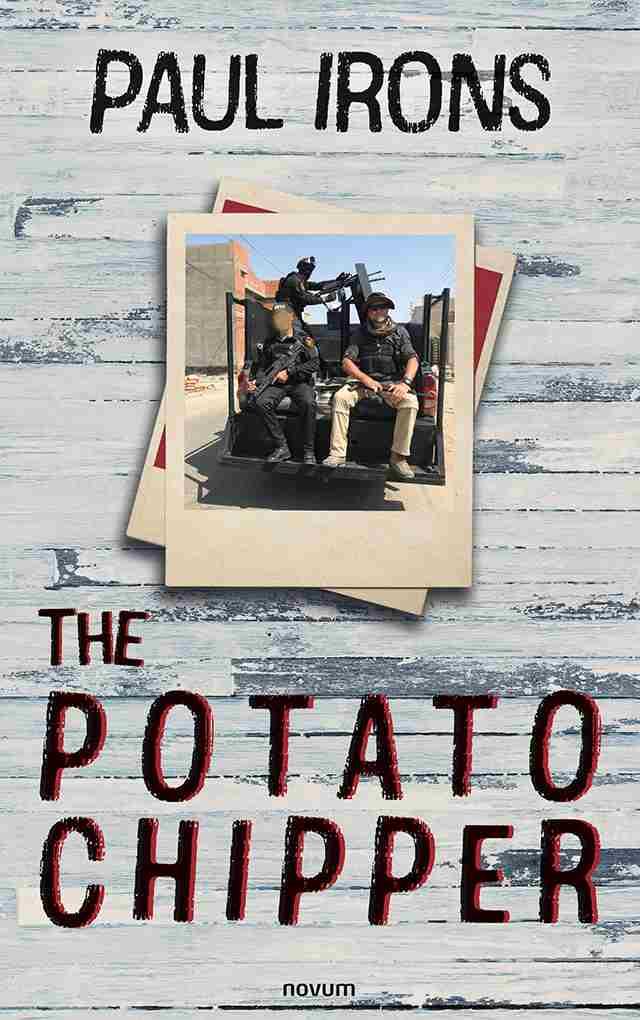


They’d turned up thinking that they would be big men, dragging in an expat security response team, looking like a load of heroes if they were indeed cops, and at worst for us at least, we’d be in Iran, open to the highest bidder as part of a political bargaining process. As I say, big mistake on their part.
The Iraqi cop at three o’clock; he who I had my weapon sighted at, turned and looked at me and gestured by showing his hand, palm to the floor in an up and down motion as if to say, ‘put the weapon down.’
‘No chance mate, you’d better get used to the feeling. You started all this’, and a million thoughts are now going through my mind about how I want to finish this. Again, I wondered if I should just drop the guy to open a whole shooting match and get this done with. I could feel my heart, in a controlled but pumping manner letting me know that it couldn’t live like this forever. ‘Just hold on in there,’ I thought.
I shot all three of them dead … in my mind. I had all three of them … then I started to think about this cop that I had in my sights, as I wondered again about dropping him, I thought about how he probably had a wife and children who needed him in this messed up land. I’d never even met him before. His mother and father would probably need him. I started to think that I would only open if absolutely necessary. This was a kind of a turning point and it was shortly after that, roughly ten minutes after the commencement of the standoff that TL Rick came back onto the radio and addressed me specifically; asking me to draw back to the third vehicle and drop my posture. He then added that we had reached a deal with the police commander to allow him to search our vehicles for drugs, and if we were indeed clear, that would resolve the issue and we would all be on our merry way.
I started to walk backwards with my weapon still at my shoulder, pointed towards our potential foes. I knew that there was a point where I would have to drop the barrel facing down to the ground. Inch by inch, while walking backwards, I dropped it and waited for this cop to use that as his chance for an advantage. I was mindful, but I needn’t have worried as Rick and the police commander were walking up together in a more jovial fashion. I opened the back of our vehicle and got the medical bags out and to all our (western eyed) amusement, the big yellow box marked ‘DRUGS,’ which none of the cops could read/understand and besides, I’d opened it up so they couldn’t see the lid.
They were satisfied. We were more than satisfied and it was after a near official handshaking, mutual saluting ceremony, in which the police commander thanked us for our efforts in assisting Iraq, that we bade farewell to our new ‘friends’ and pushed on to a safe location to make our weapons safe and feel the near orgasmic rush sensation of having pulled through a Mexican Standoff. I would say, all credit to Rick for getting us out of that one. His negotiating skills preceded him. I’m glad that my nerve held, although it certainly wasn’t the easiest of things having such a substantial rush of chemicals into my brain.
This sort of shit was taking place every day within Iraq. It may be an alien concept for a westerner to grasp but use of force and scenarios described above were how business could be conducted at those times. The returning ‘normality’ within Iraq meant a change to the rules of engagement. This included us having to entertain bent cops’ intent on giving us a hard time. It was unfortunate that in the bad old days of 2004-2009, many western convoys blasted through the checkpoints that the average citizen had to queue at, so disdain towards us was somewhat inevitable. Other individuals engaged in disgraceful activities such as shooting at locals who ‘encroached’ too close to their convoy, at times as if it were akin to sport.
A friend of mine was once involved in the purchase of weapons in Afghanistan for a security related contract. Weapons for that purpose had to be bought from local arms dealers and this would often be akin to a drug deal, with opposing teams of men, with weapons at their disposal shadowing over the exchange of cash for merchandise, ever ready for the potential double cross. This isn’t just in the movies. this does take place in real Third World life.
Key Learning Point: Regarding Daily life and power-plays, Third World Countries are very much about ‘trying it on’ to intimidate and scope out potential prey. It is very much a law of the jungle in such places that doesn’t exist in the Developed World to the same extent, and one must at times make a stand, even where it is not necessary, just to make a point. The primitive motives of such corrupt individuals are nothing more than an attempt at bullying/intimidation, which must be carefully managed if one is to undertake business affairs in such countries. It is often not practical to go in with a balls out, aggressive response as the individuals that are trying it on will usually be well connected with government officials, local politicians, the mayor etc. … and a heavy-handed response will often backfire. However, a happy medium in which you front up and make your point with words is often the best way.
Before departing from this chapter, I would be remiss if I didn’t mention one training afternoon that I enjoyed during my time in Iraq. It would be tempting to think that all this driving around across the Southern Iraq plains was accompanied by minimal work on the feet. While there would be an element of truth in this, I can tell you now, that in addition to carrying weapons and extra ammunition attached to our belts with medical bags and in some cases water, we were also wearing body armour and helmets, to hold our bodies intact should we be subjected to a blast.
Most of us, with few exceptions trained extremely hard in a variety of sporting pursuits/activities. I can tell you now that even just standing for thirty to sixty minutes with that kind of equipment on a remote site would put the body under strain. Moreover, we as a Medical and Emergency Response Team with a stretcher would be liable to carry people out potentially for several hundred metres over rough ground.
It was consequently that we started doing stretcher runs with a casualty strapped down on to the stretcher and with our mad keen (on physical exercise) team of fitness buffs, other teams soon wanted to join in our party, and we commenced doing races. That would include one guy acting as the casualty, lying on the stretcher, with four guys on either corner carrying while also bearing a helmet, body armour, other belt equipment and a rifle. These pretty much developed into full on sprint races around the camp and an interesting aside of note was that it was quite a hazardous pursuit, being in the casualty position. We took our local nationals along with us who being in a poor state of fitness suffered, and we often had to coax them physically and mentally through. We would do most of the carrying, while they followed, as best they could.
During such races however, the opposition team to us had exceptional locals fitness wise when compared with our local lads and truly worked as a team with several of the guys matching the expats as we smashed our way round a three-mile course carrying a stretcher with a simulated casualty. It shows the level of competitive spirit that the teams ran at an extremely fast pace in attempting to beat each other, and you would be surprised to learn that it was always the two guys resting (and not carrying the stretcher) that struggled to keep up with the three to four guys carrying. The strain on the legs, the sweat coursing through the eyebrows, the creaking of the wrists in holding on to the metal bars on the improvised stretcher were nearly forgotten, with the sole aim of victory. Sometimes, exuberance would get the better of us and it became risky to be the casualty as a stumble could lead to a crash that resembled a mini car crash, with bodies everywhere. As a side note, one of our local guys Hamed whom we called Sid, was aged in his late forties, early fifties. He was very disciplined, looked after the younger guys like an uncle, and was the only one of our locals that really kept going and didn’t crack. What made us all laugh was that he was wearing a green polo neck jumper that was just like Simon Templar would have worn in the Saint. It was a darned good effort on his part.
Key Learning Point: The type of ‘fitness’ required for stretcher running cannot really be trained in the gymnasium and just must be toughed out in one’s own mind. I myself found that strengthening the forearms and fingers together with a reduction in lactic acid output, with the use of bicarbonates to alkalise the blood, together with deeper breathing are a couple of factors often overlooked by all but the very elite. Olympic level athletes use bicarbonates before and after extreme training to reduce acidity in the blood as Acidity = Stress, fatigue and tiredness. Moreover, in my martial arts training, I have often used a bucket of sand to drive my outstretched fingers into, prior to clenching my fists in order to clamp around the sand, finishing off with a withdrawal & twist of my hands and slow release of the sand. Fifty to a hundred repetitions of this daily rapidly sees forearms of twisted steel develop that will be noticed by those you are introduced to in your handshakes. The final test for this phase of the aforementioned ‘iron hand/poison finger’ training entailed breaking a tile with my outstretched fingers.
I had to laugh when several US military and civilian teams that were mobile past us on the base stopped to help, thinking that we had casualties. We waved them off with a “just training, but thanks” and I was to hear later that they were more than impressed at seeing the extent to which we were physically pushing ourselves. As a side note, one of the Iraqi LN members of the opposition team had been a middle to long distance runner for the Iraqi national team at an unspecified Olympic Games; Impressive.
As we entered the long winter months, ‘the rains’ arrived in Southern Iraq and turned the territory into a bit of a rain-soaked mud bath. The conditions were at times gloomy. Fog was a persistent problem, as were the jail breaks of Al-Qaeda linked sympathisers from prisons in this part of the world. The conditions on the road meant that we reduced our cross country tracking; although when Rick was in town, we would do a lot of that and a lot of fun could be had scrambling around on the dirt, although caution was the name of the game, as there were still mines floating around from the Iran/Iraq war where the region resembled the Somme from WW1, with its system of trenches.
A few years later during my time in Iraq, I was to enter a minefield in an area further to the north of Basra called Majnoon where the fighting between Iran and Iraq had been quite fierce during the latter part of the eighties. On that occasion, I entered with a surveyor who had been one of the first Explosive Remnants of War Specialists to enter the Basra area and clear the oil field area of mines. He showed me the layout and pattern of deploying the anti-personnel mines, so I had a better idea of where to go and not to go. I was to also meet another operative, Tony, who had worked in the Lebanon some years before and had been defusing a Hezbollah device when he noticed that he was being observed.
Fearing for his safety and knowing what was about to happen next, he ran for his life and had only got so far when the observer, the trigger man for the device detonated his handiwork and Tony unfortunately lost part of his leg in the process. I found this out as he was attaching part of his prosthetic limb, as we were about to zoom off on a Polaris Cross Country Buggy that could negotiate all manner of steep ascents, descents and rough terrain.
I was never amazed by the kind of characters I would meet. The minefields and taking a walk in them would just produce a yawn from these guys, illustrating the ultimate in carefreeness, a trait that I aspire to and admire immensely. Tony had also been kidnapped in Kosovo a few years before at a Serbian checkpoint that he believed had been placed just inside the Kosovo region. Clearing mines to make the place safer, he was certain that he’d been under some sort of surveillance and the Serbs may have been annoyed at his efforts. However, he wasn’t just a soldier fulfilling duties. He was an Explosive Remnants of War clearance expert attempting to make the place just that bit safer.
Having spoken with him about this incident, he stressed that as they traversed around a blind bend, the Serb checkpoint was only twenty metres ahead and an attempt to reverse out was futile and after finding himself with the barrel of an Ak variant weapon at this nose, he and his team were dragged for about a hundred metres into a field where a mock execution took place. He modestly described this to me as we were zooming around the minefields of Majnoon, north of Basra to be a ‘sobering experience that made me think about a few things for sure on hearing the ratcheting sound of the cocking handle being pulled to the rear, in readiness for firing, positioned on his knees. The subsequent click was but a relief.’
His ability to negotiate meant that he and his team, who were questioned at a later date, separately at a Serbian Police barracks, were released unharmed. Admittedly, after paying a hundred Deutschmark fine for encroaching into Yugoslav/Serbian territory, (a point that he was pretty certain that he was innocent of, but wasn’t going to expand on at that time); his one bit of advice which I included in a report that I wrote shortly after on the subject of Kidnap for Ransom was that if questioned, be relatively honest but state the bare minimum in wording, as if you’re being cross examined by a Barrister in court in order to satisfy whoever is holding you.
He was firmly convinced that the interrogators who interviewed him knew the answers to most of the questions they were asking but wanted to verify if he were honest. Tony told me that a US military team endured a near identical episode just two weeks later. They apparently were not so lucky and were reportedly executed by their Serbian captors. I never looked into the historical facts of this latter incident, so couldn’t comment but I would have very little doubt that what Tony outlined would have had credence.
At about this time, I started writing a paper for my university dissertation related to the subject of Kidnap for Ransom. To research such a depressing subject, while at the same time knowing that I could develop new ideas that could instruct in combating what is becoming an endemic issue in the Third World gave me comfort.
12. Iraqi Winter-Wonderland
The greyness, the dampness and the generally miserable conditions within the Basra Oil field concession areas through December 2009 to January 2010 continued to increase the energy requirement just to get out of bed in the mornings. My roommate and I had a fish tank in our room and the goldfish didn’t seem to be showing any signs of struggle with the inclement weather, zipping around their tank like the submarine equivalent of a Formula 1 car.
The occasional mission excitement that was outlined earlier in previous chapters tapered off as the ‘ne’er do wells’ appeared to have retreated into their shells to hibernate. We were still occasionally traversing areas near to Basra where cars would satellite around us with strange antenna strapped to their exteriors, accelerating and then dropping back. Our countermove was to occasionally throw in a random stop, increase our distances between our vehicles, use different colour vehicles, close at checkpoints and not allow anybody to get in between us as we queued; anything just to generally ‘zig when others are zagging’. I was to really be thankful that I had worked with such a team as our movements were slick and that was not something I would attribute to all the teams in our area of operations.
We also initiated a policy of cutting around the oil fields to meet up with the various Security Escort Teams (SET) teams, in order to run through training, not only for the expatriates, but also for the locals in emergency response matters, teaching them how to effectively handle medical emergencies in a tactical environment. We would sometimes cover cross decking drills, where multiple vehicle convoy practices extracting the occupants of an immobilised vehicle, sometimes under fire; although the individual teams had usually already handled this with their own in-house training.
As the expatriate team members, mostly ex UK military with a few Australian, French, Italian, South African and US members thrown in, were formally trained in medical first person on scene, we would work them quite hard on scenarios such as chest injuries and drilling it into them to rapidly identify that an individual had an open pneumothorax; for example by presenting the scenario so that the pulse rate, respiratory rate and general baseline signs indicated such a possibility.
This is not easy as you can imagine when you are surrounded by a small but still significant percentage of the population that are hostile, in a Third World environment where medical attention may not be the best, who are wearing body armour that needs to be removed along with other cumbersome medical equipment, not forgetting weapons. We also continued to work on our training drills, particularly cross decking with patients and simulating a convoy rapid turnaround if we encountered an illegal checkpoint ahead. That would involve an initial ‘stop, stop, stop’ call, followed by a reverse (all vehicles would move in unison, at the same speed backwards) with the vehicle commander of the rear vehicle making the call as to when the driver would right hand down or left hand down was to be made and a harmonious turning of all vehicles would occur with the client vehicle (nearly always in the middle), having maximum protection from any gunfire.
Of course, there are complications with cut off groups, basically enemy insurgents set up on the roadside ready to ambush targets that are trying to evade capture at the bogus checkpoint but then, one cannot cater for every eventuality, and you just must have a starting point in your defensive arrangement, prior to proactively defeating other threats.
We also worked on driving a disabled convoy vehicle by nudging it up the road in the case of some IED related ambushes. In Northern Iraq, a few years prior, one mostly British PSC team had been hit by a low yield IED, which immobilised one of the vehicles. Initial observations (always carried out inside the vehicle prior to unlocking the doors and stepping out) had led them to believe that that was the end of the incident and that there would be no further issues. However, when two to three operatives dropped out of their vehicles to extract other members of the team, clients and kit from the immobilised vehicle, a concealed, awaiting ambush killing party struck as part of the plan which had seen them trapped in a killing zone. Most, if not all didn’t make it out, unfortunately. This area of Iraq was home to the more venomous, AQ inspired groupings that really showed no mercy to their enemies.






