Highwaymen, p.1
Highwaymen, page 1


EARLY BIRD BOOKS
FRESH EBOOK DEALS, DELIVERED DAILY
LOVE TO READ?
LOVE GREAT SALES?
GET FANTASTIC DEALS ON BESTSELLING EBOOKS
DELIVERED TO YOUR INBOX EVERY DAY!
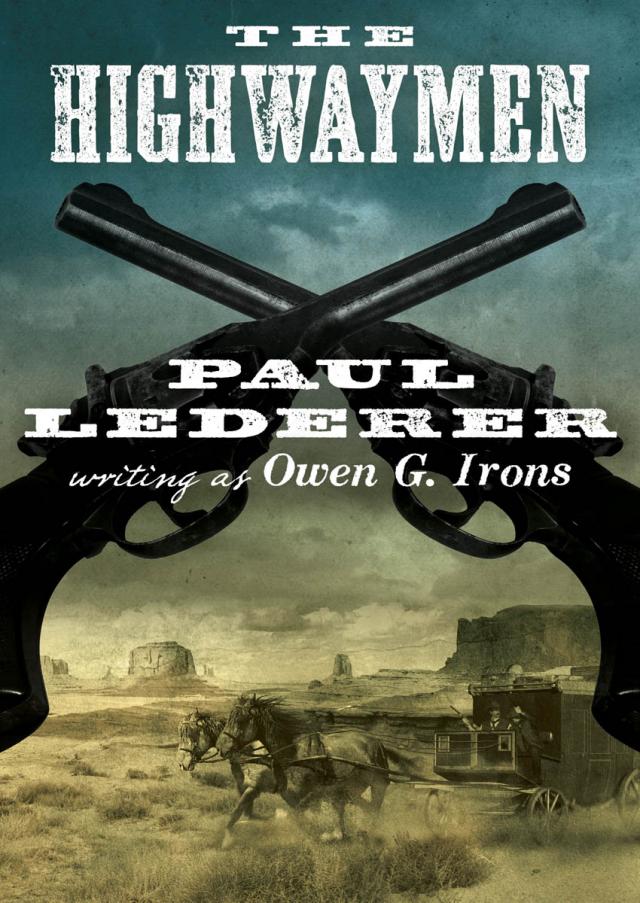
The Highwaymen
Paul Lederer writing as Owen G. Irons
ONE
Dane Hoffman had been driving on the Chicolote Stageline for nearly six years, but he had never seen this one before. As he crested the Fairmont cut-off, the full moonlight showed what seemed to be a dead man lying in the road and he reined his team in sharply. From inside the darkened coach a man’s voice – Mr Torrance’s – shouted out.
‘What now!’ He was an irritable little man with a florid face and a plain, well-padded wife who looked down her nose at the employees of the Chicolote Stageline as she probably did with any other inferiors she was unfortunate enough to be forced to deal with.
‘You just about ran him over,’ Stuart Faison, the shotgun rider said as the stage rocked and skidded to a halt.
‘Better see if there’s any help for the man,’ Dane said, and Faison nodded. Placing his shotgun aside in the coach box he clambered down heavily – for he was a large-built man – and approached the object in the road. The moonlight was clear and yellow, but the shadows along the pine-tree-lined road were deceiving. Stuart Faison approached the body, tipped back his hat and crouched down. Then he muttered a curse.
‘It’s only a log!’ he called back to Dane Hoffman, who was having some trouble controlling the nervous four-horse team.
Someone had taken a log with projecting branches on it, dressed it in a white shirt and placed a hat over the end of the stump. Now why would anyone…? Faison’s innate caution caused rapid concern to rush from the back of his mind and he stood, reaching for his holstered handgun.
‘You won’t need that,’ a voice said, and a man emerged from the pines, blue silk scarf across his face, hat tugged low. He carried a Henry repeating rifle at the ready. ‘You’d better shed that gunbelt.’
‘What is this, a hold-up?’ Faison asked with mingled anger and astonishment. His livelihood depended on his ability to keep the stage from being looted. The man with the rifle, whoever he was, answered with a touch of sarcasm.
‘It sure looks that way, doesn’t it? Drop that gunbelt before I’m forced to do something I don’t want to do.’ He took the rifle to his shoulder and aimed it squarely at Stuart Faison.
‘All right, partner,’ the big shotgun rider growled. ‘I know when a man’s got the upper hand.’
He unbuckled and dropped his gunbelt. Dane Hoffman sat on the box of the stagecoach with two thoughts in his mind. He could go for the shotgun beside him and try to stop this – assuming he did not hit Faison as well, and that was unlikely with a scattergun at this range. The second thought was that he was not going to be able to move more quickly than the highwayman could shift the sights of his rifle. He sat watching and waiting, frozen by fear and a healthy respect for the .44-.40 rifle the hold-up man was carrying. From inside the coach the self-important Mr Torrance yelled again.
‘What’s holding us up! I need to be at a meeting in Mesa at eight o’clock in the morning.’
‘Now,’ the highwayman was saying through his dark mask to Faison. ‘I want you to start walking. Right up that ridge.’ He indicated the direction he meant with his rifle barrel. ‘Not into the trees, but straight up that cleared stretch.’
‘How far do I…?’
‘Until I can’t see you any more. Or until you think you’re out of rifle range,’ the hold-up man said, again with that nasty little bit of arrogance.
‘The next time.…’ Stuart Faison began threateningly.
‘Get marching or you’ll never have a chance at a next time,’ the bandit said, and now his voice carried no humor. Faison began trudging toward the barren ridge upslope from the stage road. The highwayman watched him for a minute, then turned his attention to the coach.
‘Better loop those reins and step down, driver,’ he told Dane Hoffman. ‘Toss that shotgun over the side! How many on board?’
‘Just two. A man and his wife,’ Dane said, twisting the reins to the team around the brake handle before climbing down to the moonlit road. The man with the rifle gestured him aside. ‘Anything valuable in the boot?’
Inwardly Dane cringed. There was a small strongbox in the boot. Paper money being shipped from Tucson in exchange for gold. Enough to keep the banks in Mesa in business for another six months.
‘Yeah,’ he admitted reluctantly. What was the point in trying to deny it? ‘About thirty thousand in paper, I think.’
‘Suppose you unload that for me,’ the highwayman suggested, and Dane started that way with a shrug. He told the robber:
‘You know that they’ll rescind those serial numbers. You won’t be able to spend a dollar of it in the territory.’
‘Is that the way it works? I didn’t know that,’ the man with the rifle said as he followed Dane to the rear of the coach. ‘You’re a knowledgeable man.’
‘That’s the way it’s done – you see there are some advantages to the banks in preferring paper money over gold. You couldn’t decline to honor gold, could you?’
‘No,’ the bandit agreed. ‘I guess a man would have to spend this money fast or get out of the territory. But I guess it could be spent in Mexico, couldn’t it?’
‘I wouldn’t know,’ Dane said bitterly as he unstrapped the canvas covering on the boot and reached for the small strongbox there. ‘I never lived an outlaw’s life.’
‘No? You’d be surprised what a man can be driven to. Just drop that strongbox and climb back aboard. If your friend’s got half a brain, he’ll cut down to the road on the other side of the hill and you can pick him up there.’
‘All right. Look, mister,’ Dane said, ‘I’m telling you the truth: that is going to be hot money – you’ll never be able to spend it wherever you go.’
‘That’s all right,’ the highwayman said amiably. ‘I don’t intend to try spending it.’
Dane hesitated. He was trying to study the man enough so that he might be able to identify him one day. He was tall, wide-shouldered, wearing a dark-blue shirt, dark jeans and had a blue silk scarf covering his face. That was all that Dane would be able to testify to with any certainty. The rifle in the highwayman’s hands twitched again.
‘I believe I asked you to clamber up into the box. I want to talk to your passengers for a minute. Then you can be on your way.’
Dane turned away and did as he was told. He did not wish to argue with the man. He had dealt with this sort in his time. You never knew when their mood might change and they would start shooting. It had happened before.
The highwayman stepped to the near door of the coach and swung it wide, backing away with his rifle in a ready position.
‘Step out!’ he commanded. The little man inside bent forward to peer out. The moon paled his face.
‘What is this – a hold-up?’
‘Looks like it,’ the robber said. He repeated: ‘Step out!’
‘Tell him we refuse, Abel,’ the woman beside him urged, but Mr Abel Torrance instead slid from his seat to the ground. One never knew what these Western outlaws were capable of.
‘You too, lady,’ the highwayman ordered. ‘Or should I shoot your husband to show you that I’m serious?’
The woman hesitated as if weighing Abel Torrance’s life against her personal safety, but eventually she flounced down, skirt and petticoats billowing as she descended from the coach. Perhaps forty, she had dark hair that shone unnaturally in the moonlight, pinned tightly and topped by a tiny feathered hat.
Together the two weighed as much as a small pony. Whatever they did to make a living, food was no problem for them.
‘Show me your wallet and empty out your pockets,’ the robber ordered. He glanced toward the stagecoach box to make sure that the driver had not gotten any heroic ideas, and up toward the bare ridge to assure himself that Stuart Faison had not come up with any similarly reckless thought. The fat little man blustered.
‘You have no right –’
‘We’re not talking about rights here,’ the tall hold-up man replied. ‘We’re talking about who has the gun. Empty your pockets! Just drop it all on the ground. That’ll be fine.’ His eyes shifted to Abel Torrance’s chubby wife. ‘You, lady, what have you got that I might find valuable?’
‘My husband always carries our money. You might say he controls it all,’ she said with acerbity. The two exchanged bitter glances. Trouble does not always bring out the best in people.
The highwayman noticed this silent exchange and watched as the round man emptied his pockets, throwing his wallet down as well, but his eyes lingered on the woman. The moonlight was silver now, revealing, and at the lobes of her ears dangled intricately made gold earrings with four diamonds in each. She seemed to sense his examination and she recoiled, placing the palms of her hands over her ears.
‘Take them off,’ the highwayman said.
‘I will not!’ she said stubbornly. ‘They belonged to my great-aunt Estelle. Given to her by the King of Prussia.’
‘Take them off,’ the highwayman said again.
‘I will not!’
‘I’d hate to have to cut your ears off just to get them,’ the robber said and even by moonlight it was clear that she blanched.
‘Ruth!’ her husband pled.
‘Oh, all right!’ the woman exclaimed, and she removed the earrings. She started to hurl them to the ground, but pe rhaps respecting their lineage, she held out a trembling hand and the highwayman took them, putting them away in his shirt pocket.
‘What’s there?’ the highwayman asked, looking at the pile of trinkets and bits of paper Abel Torrance had placed at his feet.
‘Two hundred dollars expense money,’ Torrance said sourly. ‘The papers – they are my notes for the business meeting I have in the morning – if I get there. Of no value to anyone but me.’
‘I’ll keep those,’ the hold-up man said and Abel Torrance showed fire for the first time.
‘They’re of no possible use to you! Take the money and be damned – I can have more wired to me in Mesa, but I need those notes.’
The highway man was not swayed, in fact he had ceased to listen to the rotund little man. His eyes had again fixed on an object that seemed to fascinate him. ‘You’re wearing a watch,’ he said to Torrance. There was a gold chain across the man’s vest, at the end of which, obviously, a watch should rest. ‘Take it off.’
‘That is my father’s watch.’
‘Is your father alive?’
‘Not anymore. He –’
‘Then it’s not his; the dead own nothing. Now, I believe, it is mine. Unfasten it, drop it on the ground and climb back aboard the coach. I’m more than a little tired of your company.’
The watch dropped to the shadowed earth and gleamed coldly in the moonlight.
‘Now,’ the highwayman ordered roughly, ‘get back on board. Driver! Whip those ponies out of here!’
‘Just give me time.…’ the woman complained, hitching up her skirts with one hand as she fumbled for the iron handhold. Abel Torrance, perhaps understanding the urgency of the situation better than she, shoved from behind and the woman toppled into the coach interior, Torrance scrambling after her as the sound of a bullwhip cracking past the horses’ ears sent the animals into rapid, startled motion.
The highwayman was left alone in the night.
He let his eyes search the area, probing the shadows before he moved. Who knew? That shotgun rider might have decided to slink back, or there might have been some chance passer-by hidden in the trees. But nothing moved but the upper branches of the pines in the slight breeze, nothing sounded but the somewhat eerie voicing of a lone owl foraging for its midnight meal.
The highwayman returned to the copse where he had left his gray horse, led it back to the road and scooped up the articles he had taken from the Torrances. These he stuffed into his saddle-bags, except for the diamond earrings which he still carried in his shirt pocket. The strongbox was a little more of a problem. Thankfully it contained only paper and not gold. Still, it was heavy enough to give him trouble before he managed to position it across his horse’s withers.
Then with a final look around, the highwayman rode back the way he had come, through the scattered pine trees toward the pueblo of Tres Palmas.
Halfway along his route was the red stone bluff. Honeycombed with caves large and small, it had long been a hideout for men on the run. He, however, had no intention of sleeping here since he had his own bed at home and Margarita to share it with. He dropped the strongbox to the earth, swung down and carried it to one of the smaller caves, no more than six feet high and four wide, tall enough for a short man to enter without ducking.
There, in a dark corner of the nook, he placed the strongbox, emptied his saddle-bags of the other property belonging to the Torrances and removed the note he had penciled at home on the kitchen table. He spread it out on the top of the strongbox, weighted it down with the gold watch, and left, walking through the moon shadows toward his ground-hitched horse.
Swinging into the saddle he spoke. ‘Come on, Poco, it’s time to go home.’
The moon had begun to drop toward the far desert horizon. The shadows before the gray horse were long, crooked as it plodded on toward Tres Palmas. Its rider was suffering from brief remorse.
The earrings.
The ornate diamond earrings still rode in his shirt pocket. It was the first time he had kept anything from a robbery, and it was troubling him. He was not a thief, after all. But he had not liked that woman on the stage, and it seemed that, after all his work, he was due something in the way of payment. He did not want them for himself, certainly. But Margarita went without many things these days. For a time she had been forced to take in washing. Their savings, such as they were, had long ago been spent. She hadn’t had a new dress in years, and God knew that the woman deserved a small gift if he had little else left to offer. Thanks to Calvin Poole.
The lone rider’s mouth tightened at the very thought of the hated name. Calvin Poole had brought all of this on himself. ‘Well, Poole,’ the highwayman thought, ‘you’re getting some of your own back now, aren’t you?’
A few low-burning lamps glowed in the windows of the small adobe houses ahead in Tres Palmas. They led the highwayman that way as the moon dimmed and fell to darkness.
TWO
Marshal Patrick Donovan sat unhappily behind his desk in his Mesa, Arizona, office. The evening had started out badly and gotten worse. The Price brothers had decided to shoot up the Golden Eagle saloon around midnight for no particular reason that anyone knew of. Later still Clarissa Townshend had set fire to her little house on the edge of town, as she did periodically to frighten off the ‘spirits’. A bucket brigade had put the fire out fairly quickly, and the house, being built of adobe block, had not suffered serious damage. No sooner had Donovan returned to the shelter of his room, rinsed the soot from his face and the blood from his knuckles and placed his head down on his pillow than the westbound Chicolote stage drew up before the office and a group of people swarmed toward the door, cursing, crying, shouting and complaining at once.
Donovan knew two of the people – the stagecoach driver, Dane Hoffman and his shotgun man, Stu Faison. The other two were passengers: a portly red-faced gent in a town suit and his harridan wife who stood about six inches taller than her husband. They introduced themselves, when they eventually got around to it after shrieking and shouting complaints at the weary town marshal, as Mr and Mrs Torrance.
‘Tell me again what happened,’ Marshal Donovan said, his voice gravelly from yelling at the Price brothers, from inhaling smoke at Mother Townshend’s house. ‘One at a time, please!’
His guests were not in the mood to be orderly with their complaints. It didn’t help any that Ben and Luke Price continued to yell from the back jail cell, demanding that they either be released or given whiskey.
‘Man stopped us on the Fairmont Grade,’ Dane Hoffman began excitedly. ‘He had thrown a log across the road –’
‘It looked like a man,’ Stuart Faison interrupted, equally excited.
‘Wait a minute,’ Marshal Donovan said, holding up a hand. ‘You said it was a man who stopped you. Are you now saying it could have been a woman?’
‘I’m saying the log looked like a man,’ Stu Faison pressed on, surprised by the marshal’s lack of comprehension. ‘He had dressed the log up to resemble a man.’
‘I see,’ Donovan said wearily.
‘Whiskey!’ one of the Price brothers demanded. Donovan rose to close the door connecting the jail cells with the office.
‘He took my father’s watch!’ the round little man, Torrance, complained loudly.
‘Your father?’ Donovan looked around the room. ‘Where is he?’
‘In his grave!’ Torrance said.
Resting more comfortably than Patrick Donovan, the marshal hoped.
‘He was rude,’ the woman said, ‘he nearly molested me.’
Donovan wasn’t sure how someone could nearly be molested, but he let it pass. The woman was grinding her teeth. She had a horsy face, and the motion of her jaws only strengthened the resemblance.
‘Did anyone get a good look at him?’ Donovan wanted to know.
‘He wore a mask, of course,’ Ruth Torrance said, ‘but he had evil eyes.’
Donovan pretended to write that down. Her description of the man would do a lot of good on a Wanted poster. Just then the door burst open again and Calvin Poole, owner of the Chicolote Stage Company tramped in, looking self-important. Behind the bulky Poole, two of the town’s three bankers, both rumpled, tieless and out of breath, entered the room.
‘What’s this about another robbery?’ Poole demanded, hooking his thumbs into his vest pockets. He rocked on his heels and stared accusingly at Donovan as if the town marshal were complicit in the matter.