Solomons song, p.1
Solomon's Song, page 1


©1989, 2014 by
ROBERTA KELLS DORR
All rights reserved. No part of this book may be reproduced in any form without permission in writing from the publisher, except in the case of brief quotations embodied in critical articles or reviews.
Interior design: Ragont Design
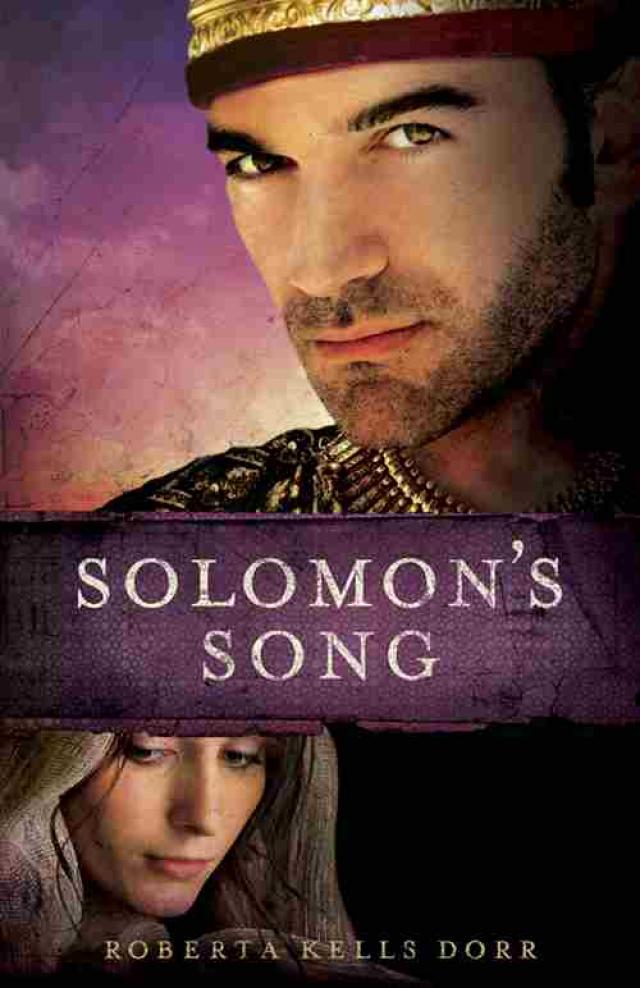
Cover design: Brand Navigation, LLC
Cover images: Woman: Shutterstock / 45457591 / © Ivan Feoktistov
Man: Shutterstock / 79845391 / © CURAphotography
Pattern in Horizontal Bar: iStock LP / 6836464 / © naelnabil
Solomon’s Crown: iStock LP / 18598022 / © talymel
Solomon’s Shirt/Armor: iStock LP / 11610880 © Valentin Casarsa
Library of Congress Cataloging-in-Publication Data
Dorr, Roberta Kells.
Solomon’s song / Roberta Kells Dorr.
pages cm
Originally published: San Francisco : Harper & Row, c1989.
Summary: “The sadness and the tenderness of life are felt so acutely in the presence of beauty, and love is revealed more in our sorrow than in our joy. -Solomon, from Solomon’s Song. The wisest of all kings, beloved son of King David and his wife Bathsheba, builder of a prosperous empire, lover to many wives and concubines-King Solomon was once merely a son of David with no guarantee of ever taking the throne. On the cusp of adulthood, with no direction in life, Solomon found himself infatuated … in love with a lowly shepherdess, a young maiden chosen for his father to serve David in his later years. Overhead clouds ceased to discharge life-giving rain, and the anxious people looked to King David for relief from the famine. In their weakness they turned from Yahweh and sacrificed to foreign gods. But the David’s eldest son, Adonijah had a plan, one that could cost the Benjamites their lives. Revenge. Solomon was still Bathsheba’s eldest son and with it came certain family expectations. His mother wanted nothing less than the throne for her eldest living son. He must marry a princess first, and then he can marry any common woman he desired. Solomon s struggled against family expectations and his chief rival, his own brother, Adonijah; he fought against the most disappointing aspect of his quest to become ruler. ‘Love is nothing, when pitted against strength and power.’”—Provided by publisher.
ISBN 978-0-8024-0955-3 (pbk.)
1. Solomon, King of Israel—Fiction. 2. Bible. Old Testament—History of Biblical events—Fiction. 3. Israel—Kings and rulers—Fiction. I. Title.
PS3554.O694S6 2014
813’.54—dc23
2013034186ISBN
We hope you enjoy this book from River North Fiction by Moody Publishers. Our goal is to provide high-quality, thought provoking books and products that connect truth to your real needs and challenges. For more information on other books and products written and produced from a biblical perspective, go to www.moodypublishers.com or write to:
River North Fiction
Imprint of Moody Publishers
820 N. LaSalle Boulevard
Chicago, IL 60610
1 3 5 7 9 10 8 6 4 2
Printed in the United States of America
To my daughter, Debby
who like Shulamit
has a special love for
plants and animals
Contents
Prologue
Chapter 1
Chapter 2
Chapter 3
Chapter 4
Chapter 5
Chapter 6
Chapter 7
Chapter 8
Chapter 9
Chapter 10
Chapter 11
Chapter 12
Chapter 13
Chapter 14
Chapter 15
Chapter 16
Chapter 17
Chapter 18
Chapter 19
Chapter 20
Chapter 21
Chapter 22
Chapter 23
Chapter 24
Chapter 25
Chapter 26
Chapter 27
Chapter 28
Epilogue
Excerpt from David and Bathsheba
Excerpt from Harvest of Rubies
Love is as strong as death;
jealousy as cruel as the grave
(KING JAMES VERSION)
Friend,
Thank you for choosing to read this Moody Publishers title. It is our hope and prayer that this book will help you to know Jesus Christ more personally and love Him more deeply.
The proceeds from your purchase help pay the tuition of students attending Moody Bible Institute. These students come from around the globe and graduate better equipped to impact our world for Christ.
Other Moody Ministries that may be of interest to you include Moody Radio and Moody Distance Learning. To learn more visit
http://www.moodyradio.org/ and http://www.moody.edu/distancelearning/
To enhance your reading experience we’ve made it easy to share inspiring passages and thought-provoking quotes with your friends via Goodreads, Facebook, Twitter, and other book-sharing sites. To do so, simply highlight and forward. And don’t forget to put this book on your Reading Shelf on your book community site.
Thanks again, and may God bless you.
The Moody Publishers Team
Prologue
The sound of a flute rose and fell with a lonesome, wistful insistence, giving voice to the moonlight and making the unseen listener grieve with a sorrow deeper than tears. Leaning over the parapet, the king saw that the musician was a young shepherd boy, who probably felt only the poignancy that always seems entwined with a jasmine-scented night.
“How is it,” Solomon wondered as he watched the slow movement of the branches on the palm trees that lined the courtyard below, “that the sadness and the tenderness of life are felt so acutely in the presence of beauty, and love is revealed more in our sorrow than in our joy?”
The shepherd’s notes grew faint as the boy moved down the path toward the valley. The king turned from the parapet with a sigh and walked through the curtained doorway into the richly draped and carpeted room where his young scribe still sat crosslegged on the floor, writing the day’s accounts.
The boy must have been startled by the king’s silent, brooding look. He let the stylus fall from his hand and bounded forward to kneel before Solomon.
“There’s no need to be distressed,” Solomon said gently as he stooped and lifted him to his feet. “Let’s be done with the matters of the court and the problems of the day. Tonight is a special night—a night to ponder old memories and then lock them away for some future date, some future time.”
He motioned for the boy to bring out a parchment in gold-embroidered wrapping from under the cushions by his bed. “I’ll sit here and listen while you read to me the story of the most beautiful girl in the world, the song of a love that was stronger than death and jealousy more cruel than Sheol, the most glorious song I’ve ever written: The Song of Songs.”
Solomon sat down and leaned back among the cushions where his face would be hidden by the shadows, so that the young scribe couldn’t see the emotion that came and went on his face or the tears that flooded his eyes. As the scribe read, Solomon remembered the beloved face and gentle hands of the Shunammite maiden and all that had passed between them. He remembered her words to him:
“Come, my beloved, let us go out to the vineyards.
Let us get up early and go out to see whether the vines have budded,
Whether the blossoms have opened, and
Whether the pomegranates are in flower.
There I will give you my love.”
The scribe read well the words of the maiden just as she had said them and as Solomon, remembering, had recorded them. Solomon could see her dark hair caught carelessly in the folds of coarse linen that framed her face, making the small, curled tendrils that escaped more dear.
She was always shy, leaving her eyes to say much more than her lips. From the very beginning there had been some mysterious, wordless flow of feeling between them that made him feel completely accepted and loved. There was no part of her, except her eyes, that he remembered as being separate and distinct from any other. Like a rare jewel cut by a skilled craftsman, she was perfect in every way.
“Your neck is stately as an ivory tower,
Your eyes as limpid pools in Heshbon by the gate of Bath-rabbim.
The king is held captive in your queenly tresses!”
How true the words had proven to be!
The scribe read on and on from the scroll that had been written by the king’s own hand on the finest of parchments. The king heard only fragments, however, for suddenly the room seemed peopled with voices from the past. Once again he could picture the day just as it had been and the events that led up to the first time he saw her.
The pain of remembering such lost joy and happiness was almost unendurable. Yet he couldn’t turn back from it. This was the night for remembering, and he was a man who faced life squarely and didn’t shrink from the pain, lest he also lose something of the joy.
It was his eighteenth birthday. It should have been a day of festivity and rejoicing, but because of the famine that held the land in a deathlike grip Solomon expected no celebration. Instead, he chose to ride out and observe for himself the plight of the people.
His close-cropped dark hair outlined a strong, tanned face with eyes that were often described as deep and quiet. His mouth was full and sensuous with an inclination to smile, showing strong white teeth and a firm, well-shaped jaw. Solomon was young and hand some, as were all of David’s sons.
Today there was no laughter as he rode with his younger brother Nathan down the ridge toward his father’s lands at Bethlehem. He saw the devastation of three years of drought, and his expression was grim and troubled. In every village he saw men and women with large, frightened eyes, children with distended abdomens, cattle frail and emaciated. The fields of barley that were usually bright green at this time of year stood in dwarfed brown spears.
In the palace they had heard that the people were close to rioting. Solomon could see that this was true. “We’ve already lost the barley harvest,” they complained to him. “We must have rain by Passover or we’ll lose the wheat also. The king must do something.”
When Solomon reached Bethlehem, he found the situation even worse. The great stretch of fertile basin that had been the pride of Boaz, then Obed and Jesse, was now a swirling dustbowl. The men of the village sat in small, dispirited groups at the city gate, their faces dark, their eyes hopeless, and their mouths twisted with bitterness. The women listlessly ran their hands over silent grindstones or rocked the whimpering babies.
“Water must be the strongest thing in the world,” Solomon remarked to Nathan as they rode back to Jerusalem. “Without it a whole nation can be brought to starvation and death.”
Nathan was always amused at how his brother loved to analyze everything. He himself was a student of the Law, and his lessons with the prophet Nathan didn’t leave room for such fanciful speculation.
“I don’t agree at all,” Nathan said. “Water is necessary for things to grow, but to do that it must disappear into the ground—and then it’s no longer water.”
“You’re right,” Solomon’s eyes were wide and alert as he mulled over the problem. “Then,” he asked, “what is the strongest thing in the world?”
Without hesitation Nathan replied, “Why, rocks, of course. That rock over there will never go away or change. It was there when our father Abraham passed this way.”
Solomon gave his brother a playful push. “It isn’t fair. I spend so much time trying to understand things, and you know the answers without even thinking.”
Nathan nodded. “Things are seldom fair. I’m free to do as I wish; you can’t.”
“You’re right. Just yesterday I had a quarrel with our mother. Now she wants me to marry a princess from Rabbath-ammon.”
“She wants to put you ahead of Adonijah for the throne.”
Solomon made a dismissive gesture. “I’ve heard that the princess is plain and has a sharp tongue.”
“Perhaps,” said Nathan. “But she is a princess. Mother’s even planned a surprise for your birthday so you can travel in style to get your bride.”
Bride. Solomon stiffened as he gave his mule a brisk flick with his prod, making him lunge forward down the path.
* * *
Back in Jerusalem Bathsheba, Solomon’s mother, was finishing preparations for her favorite son’s birthday. She had not only prepared a celebration but had commissioned old Tobias, an Egyptian craftsman, to build a palanquin of intricate and cunning design. The celebration would be a relief, she reasoned; it would be good for them to forget for a few hours all the concern over the lack of rain.
Almost everyone in Jerusalem had been involved in planning for the special day or making the unusual birthday gift. Some of Bathsheba’s maidens had carefully woven a golden canopy, while others had decorated the seat and back with fine needlework. To everyone’s delight, the palanquin had been finished on time and stood waiting for Solomon’s return from Bethlehem. Excitement mounted as the maidens anticipated the final unveiling, which would reveal a panel of black ebony with a needlework insert that carried their secret and daring message.
* * *
By late afternoon a group of young women had assembled in the tower room above Jerusalem’s South Gate. They primped and gossiped and even laughed in a way that hadn’t been heard in months. From time to time they excitedly glanced out the high, narrow window that looked down the Kidron Valley toward Bethlehem.
They were just beginning to get impatient and fretful when a young girl named Yasmit screamed, “He’s coming!” She grabbed her tambourine and pushed through the shrill laughter and nervous giggles to get to the door first. Others quickly followed, while a few clambered up to look out the window so they too could see the flying banners and bright swords of the young men who rode with the prince.
Yasmit looked back and grabbed her younger sister’s hand, roughly pulling her down the steps as she whispered, “Hurry! I want to get close enough to really see the prince.”
“I hope you’re not going to do anything foolish,” her sister admonished as they moved with the young women into the open space before the gate.
There was the usual fanfare of trumpets as the gates opened and Solomon came riding through, looking rather dusty but still regal and handsome. At first, seeing the young women, his face registered surprise. Then he pulled the reins taut and broke into a merry laugh. Quickly he urged his mule on and rode before the maidens up the narrow streets to the open courtyard before the palace.
The women sang as they beat a steady rhythm on their tambourines and kept time with their slapping feet on the cold stones of the cobbled court. “He is strong and handsome; his eyes are tender and warm.” One voice, the voice of Yasmit, rang out higher and more strident than all the rest. Boldly she reached for the bridle of Solomon’s mule and led him to the place where Tobias stood with some of the palace guards beside a large covered object.
Laughing boyishly, Solomon dismounted and greeted Tobias with a warm handclasp. “What’s this?” he bantered, pointing to the bulky form.
“My lord—” Tobias didn’t finish his sentence, for at that moment there was a stir off to one side as a tall figure, richly dressed, rode into the midst of the courtyard. He forced his mule through the shrieking women and dismounted.
It was Adonijah, the crown prince and oldest son of David by his wife Haggith. He ignored Solomon as he faced Tobias with cold contempt. “Old man, by what right do you make such a commotion in the king’s courtyard?”
Tobias cringed, but Solomon stepped forward boldly. “It’s not the king who is disturbed, but you, my brother. Our father loves festivals and encourages surprises.”
“A festival?” Adonijah looked at the women crowded around the strange covered object. “A surprise? What surprise can there be that I know nothing of?”
“I’m eighteen today,” Solomon said, smiling at Adonijah’s obvious discomfort, “and my friends have made something for me. There seems to be some mystery about it. Come,” he ordered the old man with mock sternness, “let’s see your workmanship.”
With a nod Tobias motioned for the maidens to remove the covering and reveal the new palanquin. Solomon was speechless. He bent down and examined its silver posts and golden canopy. He ran his hand over the warm cedarwood and traced the etching done on the silver casings. Then he noticed the seat of fine woven purple, embroidered with his own seal.
The young women and their parents grew silent as Solomon inspected the finely wrought ebony back and to read the words embroidered on the royal purple fitted into the center. At first he read them silently, then he smiled and read them aloud for all to hear: “With love from the maidens of Jerusalem.”
He glanced around. His eyes were twinkling and his mouth curved into the half-smile that all of them found so irresistible. “Thank you, thank you,” he said, as the tambourines again began to shake and the dance became hurried and insistent.
Suddenly, amidst the joyful noise and general uproar, Yasmit pushed her way to the front and brazenly looked into the prince’s face. “Do you wish for love?”
“I’ve never been in love, so I don’t really know.” Solomon’s eyes crinkled with amusement. He was obviously not moved to return her ardor, though he was flattered as always by the unsought attention he drew from women wherever he went.
“I’ve been in love often and have found it to be the most pleasant of experiences,” Adonijah said, looking at Yasmit and giving her a bold challenge with his eyes. For a moment she looked from Solomon to his older brother; then, most deliberately, she turned from Solomon. “Let him have the love of the maidens of Jerusalem,” she snapped. “I’m looking for something more warm and personal.” The last words were said with a tilt of her head and a sly, suggestive timbre to her voice.