How to eat, p.1
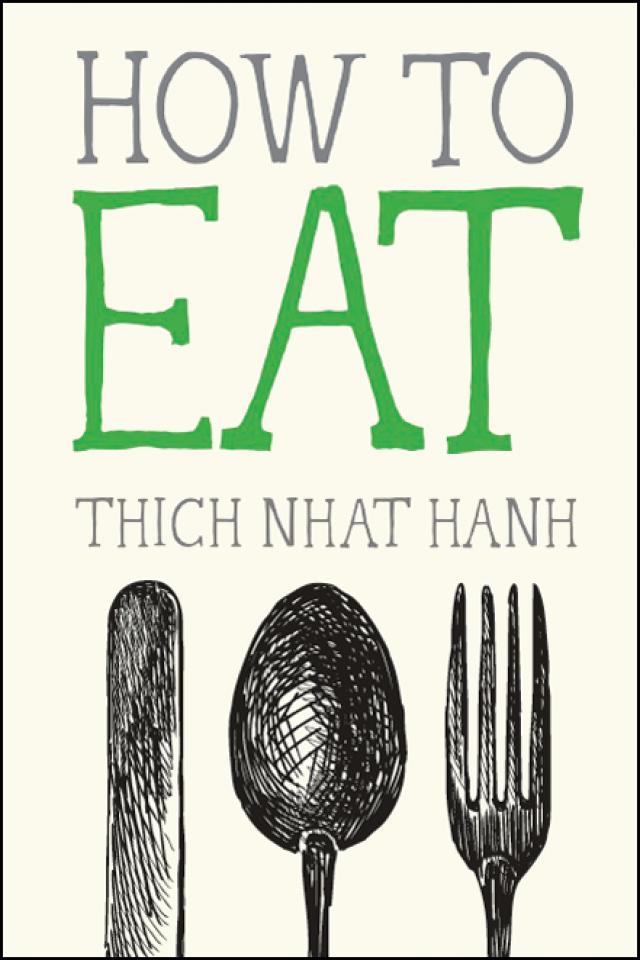
How to Eat, page 1


Parallax Press
P.O. Box 7355
Berkeley, California 94710
www.parallax.org
Parallax Press is the publishing division of Unified Buddhist Church, Inc.
© 2014 by Unified Buddhist Church
All rights reserved
Cover and text design by Debbie Berne
Illustrations by Jason DeAntonis
ISBN: 978-1-937006-73-0
Library of Congress Cataloging-in-Publication Data
Nhat Hanh, Thich, author.
How to eat / Thich Nhat Hanh ; illustrated by Jason DeAntonis.
pages cm
1.Meditation—Buddhism. 2.Dinners and dining—Religious aspects—Buddhism.I. Title.
BQ9800.T5392N45448 2014
294.3’444—dc23
2014015222
1 2 3 4 5 / 18 17 16 15 14
CONTENTS
Notes on Eating
MINDFUL EATING
NOTHING COMES FROM NOTHING
YOUR BODY BELONGS TO THE EARTH
EATING WITHOUT THINKING
WAITING WITHOUT WAITING
SLOWING DOWN
PAYING ATTENTION TO JUST TWO THINGS
EACH SPOONFUL CONTAINS THE UNIVERSE
BREATHING COMES FIRST
TURNING OFF THE TV
HOW MUCH IS ENOUGH
PREPARING A MEAL
THE KITCHEN
A KITCHEN ALTAR
COOKING WITHOUT RUSHING
PRACTICING PEACE WHILE CHOPPING VEGETABLES
SETTING THE TABLE
COOKING WITH JOY
A GRAIN OF RICE CONTAINS THE UNIVERSE
COMMUNION
TAKE YOUR TIME
AN AMBASSADOR OF THE COSMOS
CHEW YOUR FOOD, NOT YOUR WORRIES
NOURISHED BY THE PRACTICE
FOOD AS MEDICINE
HEALING
TURNING OFF THE RADIO
OUR ANCESTORS ARE IN THE SOIL
EATING MINDFULLY IS A PRACTICE
EATING IN SILENCE
EATING A STRING BEAN
NOURISHED BY THE PRESENT MOMENT
HOW THE BUDDHA ATE
THE VALUE OF A MEAL
SITTING WHILE YOU EAT
ONE MINDFUL BREATH
THE RIGHT AMOUNT
A SILENT MEAL
A MEAL AT GOOGLE
ARRANGING A MEAL
EATING IS AN ART
CHOOSING WHAT TO EAT
A VEGETARIAN DIET
THE PLANET IS US
BON APPÉTIT!
ATTENTION TO WHAT WE EAT
BOUND BY A HUNDRED STRINGS
MEDITATION AS FOOD
WHAT A BABY EATS
ORGANIZING A MEAL
EATING AND SMILING
EATING WITH CHILDREN IN SILENCE
CULTIVATING COMPASSION
MINDFUL CONVERSATION AT MEALTIME
INVITING THE BELL AT MEALTIME
THE PURPOSE OF BREAKFAST
A FULL LIFE
GETTING SUPPORT
TRULY SEEING
ENJOYING DISHWASHING
DISHWASHING AS MEDITATION
DRINKING A CLOUD
SNACK MEDITATION
THE RIGHT AMOUNT
SNACKING
EATING OUR FEELINGS
NOURISHING OURSELVES WITH MINDFULNESS
MINDFUL CONSUMPTION IS FOR EVERYONE
THE JOY OF EATING
Contemplations for Eating
CONTEMPLATING OUR MEAL
PRACTICING WITH THE FIVE CONTEMPLATIONS
THE FIVE CONTEMPLATIONS
A GIFT OF THE EARTH
GRATITUDE
EATING WITH MODERATION
EATING TO REDUCE SUFFERING
NURTURING ALL BEINGS
SIX FOOD CONTEMPLATIONS FOR YOUNG PEOPLE
SERVING FOOD
LOOKING AT YOUR PLATE
BEGINNING TO EAT
LOOKING AT YOUR EMPTY BOWL
FINISHING YOUR MEAL
HOLDING YOUR CUP OF TEA
BATHING A BABY
COMPOSTING OUR FOOD SCRAPS
A WAY OUT
RELATED TITLES
NOTES ON EATING
MINDFUL EATING
To cultivate mindfulness, we can do the same things we always do—walking, sitting, working, eating, and so on—with mindful awareness of what we are doing. When we’re eating, we know that we are eating. When we open a door, we know that we’re opening a door. Our mind is with our actions.
When you put a piece of fruit into your mouth, all you need is a little bit of mindfulness to be aware: “I am putting a piece of apple in my mouth.” Your mind doesn’t need to be somewhere else. If you’re thinking of work while you chew, that’s not eating mindfully. When you pay attention to the apple, that is mindfulness. Then you can look more deeply and in just a very short time you will see the apple seed, the beautiful orchard and the sky, the farmer, the picker, and so on. A lot of work is in that apple!
NOTHING COMES FROM NOTHING
With just a little bit of mindfulness, you can truly see where your bread comes from. It has not come from nothing. Bread comes from the wheat fields, from hard work, and from the baker, the supplier, and the seller. But the bread is more than that. The wheat field needs clouds and sunshine. So in this slice of bread there is sunshine, there is cloud, there is the labor of the farmer, the joy of having flour, and the skill of the baker and then—miraculously!—there is the bread. The whole cosmos has come together so that this piece of bread can be in your hand. You don’t need to do a lot of hard work to get this insight. You only need to stop letting your mind carry you away with worrying, thinking, and planning.
YOUR BODY BELONGS TO THE EARTH
In modern life, people tend to think their bodies belong to them, that they can do anything they want to themselves. But your body is not only yours. Your body belongs to your ancestors, your parents, and future generations. It also belongs to society and to all the other living beings. The trees, the clouds, the soil, and every living thing brought about the presence of your body. We can eat with care, knowing we are caretakers of our bodies, rather than their owners.
EATING WITHOUT THINKING
When we eat we usually think. We can enjoy our eating a lot more if we practice not thinking when we eat. We can just be aware of the food. Sometimes we eat and we’re not aware that we’re eating. Our mind isn’t there. When our mind isn’t present, we look but we don’t see, we listen but we don’t hear, we eat but we don’t know the flavor of the food. This is a state of forgetfulness, the lack of mindfulness. To be truly present we have to stop our thinking. This is the secret of success.
WAITING WITHOUT WAITING
When we serve ourselves food and then bring it to the table, we don’t need to feel we’re waiting for other people to serve themselves and be seated. All we have to do is breathe and enjoy sitting. We haven’t eaten our meal yet, but we can already feel joy and gratitude. It’s an opportunity for us to be peaceful.
Standing in line at a grocery store or a restaurant, or waiting for the time to eat, we don’t need to waste our time. We don’t need to “wait” for one second. Instead, we can enjoy breathing in and out for our nourishment and healing. We can use that time to notice that we will soon be able to have food, and we can be happy and grateful during that time. Instead of waiting, we can generate joy.
SLOWING DOWN
When we can slow down and really enjoy our food, our life takes on a much deeper quality. I love to sit and eat quietly and enjoy each bite, aware of the presence of my community, aware of all the hard and loving work that has gone into my food. When I eat in this way, not only am I physically nourished, I am also spiritually nourished. The way I eat influences everything else that I do during the day.
Eating is as important a time for meditation as sitting or walking meditation time. It’s a chance to receive the many gifts of the Earth that I would not otherwise benefit from if my mind were elsewhere. Here is a verse I like to recite when I eat:
In the dimension of space and time,
We chew as rhythmically as we breathe.
Maintaining the lives of all our ancestors,
Opening an upward path for descendants.
We can use the time of eating to nourish the best things our relatives have passed onto us and to transmit what is most precious to future generations.
PAYING ATTENTION TO JUST TWO THINGS
While we eat, we can try to pay attention to just two things: the food that we’re eating and our friends who are sitting around us and eating with us. This is called mindfulness of food and mindfulness of community. Eating mindfully, we become aware of all the work and energy that has gone into bringing the food to us. If we are eating with others, we can notice how wonderful it is that during this sometimes hectic life we can find the time to sit together in a relaxed way like this to enjoy a meal. When you can breathe, sit, and eat together with your family or friends in mindfulness, this is called true community-building.
EACH SPOONFUL CONTAINS THE UNIVERSE
Pay attention to each spoonful of food. As you bring it up to your mouth, use your mindfulness to be aware that this food is the gift of the whole universe. The Earth and the sky have collaborated to bring this spoonful of food to you. While breathing in and out, you only need a second or two to recognize this. We eat in such a way that every morsel of food, every moment of eating has mindfulness in it. It takes only a few seconds to see that the food we’re holding in our spoon is the gift of the whole cosmos. W
BREATHING COMES FIRST
The first thing to do when you sit down with your bowl of food is to stop the thinking and be aware of your breathing. Breathe in such a way that you are nourished. You are nourished by your breathing and you nourish other people with your practice of breathing. We nourish one another.
TURNING OFF THE TV
Sometimes people eat while watching TV. But even if you turn off the TV, the TV in your mind continues to run. So you have to also stop the TV in your head. If there is thinking still going on in your mind, you’ll be dispersed. To be truly present you need to not just turn off the television or radio in your house, you need to turn off the conversation and images in your head.
HOW MUCH IS ENOUGH
We don’t need to eat a lot to feel nourished. When we are fully there and alive for every morsel of food, we eat in a way that each bite fills us with peace and happiness. If we are full of this joy, we may find that we naturally feel satisfied with less food.
PREPARING A MEAL
When you prepare a meal with artful awareness, it’s delicious and healthy. You have put your mindfulness, love, and care into the meal, then people will be eating your love. People can fully enjoy the meal with body and mind, just like you enjoy a beautiful work of art. Eating is not only nourishing for the body, but also for the mind.
THE KITCHEN
The kitchen can be a meditative practice space if we practice mindful awareness while we are cooking and cleaning there. We can set an intention to execute our tasks in a relaxed and serene way, following our breathing and keeping our concentration on what we are doing. If we are working with others, we may only need to exchange a few words about the work at hand.
A KITCHEN ALTAR
In your own kitchen, you might want to create a kitchen altar to remind yourself to practice mindfulness while cooking. It can be just a small shelf with enough room for an incense holder and perhaps a small flower vase, a beautiful stone, a small picture of an ancestor or spiritual teacher, or a statue—whatever is most meaningful to you. When you come into the kitchen, you can begin your work by offering incense and practicing mindful breathing, making the kitchen into a meditation hall.
COOKING WITHOUT RUSHING
While cooking, allow enough time so you don’t feel rushed. If we are aware that our bodies and those of our loved ones depend on the food we’re preparing, this awareness will guide us to cook healthy food infused with our love and mindful attention.
PRACTICING PEACE WHILE CHOPPING VEGETABLES
Peace can be practiced while chopping vegetables, cooking, washing dishes, watering the vegetable garden, and also while driving or working. Practice releasing the tension in body and mind and being completely with your task. The time when you work in the kitchen is also the time for meditation.
SETTING THE TABLE
Eating a meal in mindfulness is an important practice. We turn off the TV, put down our newspaper, and work together for five or ten minutes, setting the table and finishing whatever needs to be done. During these few minutes, we can be very happy. When the food is on the table and everyone is seated, we practice breathing. “Breathing in, I calm my body. Breathing out, I smile,” we repeat three times. We can recover ourselves completely after three breaths like this.
COOKING WITH JOY
Cooking can bring us a lot of joy. When I put the water into the basin for washing the vegetables, I look deeply at the water to see its wonderful nature. I see that the water comes from high in the mountains or from deep within the Earth right into our kitchen. I know that there are places where people have to walk several miles just to carry back a pail of water on their shoulders. Here, water is available whenever I turn on the tap. Aware of the preciousness of clean water, I value the water that is available to me. I also value the electricity that I use to turn on a light or to boil water. I only need to be aware that there is water and electricity easily accessible to me, and I can be happy straightaway. When I am peeling vegetables or cooking them, I can do it in mindfulness and with love. I see cooking as a way to offer nourishment and care to my family and friends. I will easily find joy and peace in the work. Looking deeply at a tomato, a bunch of grapes, or a piece of tofu, I can see the wonderful nature of these things, how they were nurtured by the soil, the sun, the rain, and the seed. Try to organize your life so that you have enough time and energy to cook in a leisurely and peaceful way. The energy of love and harmony in the kitchen will penetrate into the food that you’re cooking to offer to your loved ones and yourself.
A GRAIN OF RICE CONTAINS THE UNIVERSE
When we look at a grain of rice, one second of mindfulness and concentration allows us to see that this grain contains the whole world—the rain, the cloud, the Earth, time, space, farmers, everything. Mindfulness and concentration bring insight, and suddenly we can see so much in a grain of rice. It’s very quick! Wherever there is mindfulness and concentration, there is insight. When you put that grain of rice into your mouth, you are putting the whole universe in your mouth. This is possible when you stop your thinking. When you chew that grain of rice, just chew, so no thinking will cut you off from this wonderful reality.
COMMUNION
In some traditions, monastics want to take their minds off food and focus on the virtues of a spiritual life. In my tradition, we do the opposite. We just focus on the food. We see the food as the cosmos. In the Catholic tradition, in the Eucharist you see the piece of bread as the body of Jesus. In the Buddhist tradition, we see the piece of bread as the body of the cosmos. Everything is there. When you chew it mindfully, without thinking, you can see very well all that the piece of bread contains. That is why when you take a bite of the bread and chew mindfully, you are truly in communion with all of life.
TAKE YOUR TIME
It’s good to take time to eat, because the time for a meal can be a very happy time. Take time to enjoy your breakfast, lunch, and dinner. Enjoy your meal. Stop the thinking and be there fully, body and mind.
AN AMBASSADOR OF THE COSMOS
When you pick up an ear of corn, take one second to look at it. You can see the Earth, the sunshine, and the rain in the corn. Everything has come together to produce that corn you are holding. So the corn is an ambassador coming to nourish you. It only takes one or two seconds to get that insight. When you put the corn into your mouth, chew it mindfully and greet the universe.
CHEW YOUR FOOD, NOT YOUR WORRIES
Sometimes we eat, but we aren’t thinking of our food. We’re thinking of the past or the future or mulling over some worry or anxiety again and again. So stop thinking about your business, about the office, or about anything that isn’t happening right now. Don’t chew your worries, your fear, or your anger. If you chew your planning and your anxiety, it’s difficult to feel grateful for each piece of food. Just chew your food.
NOURISHED BY THE PRACTICE
Try to be present with your food and with the people sitting around the table with you. Don’t close your eyes or look down while you chew. You can open your eyes and if you are with people, notice them alive and well. When we chew with awareness, we’re not just nourished by the food, we’re nourished by our practice of mindfulness, peace, and happiness. While we chew, we breathe and we enjoy our breathing and our ability to eat and receive nourishment from our food.
FOOD AS MEDICINE
In the original Five Contemplations as they were recited during the Buddha’s time, food was considered to be medicine. But I think that when the Buddha received good food, he also enjoyed it. I don’t think he thought of it as just taking medicine. We know the food nourishes our bodies. But we can also appreciate and savor our food.