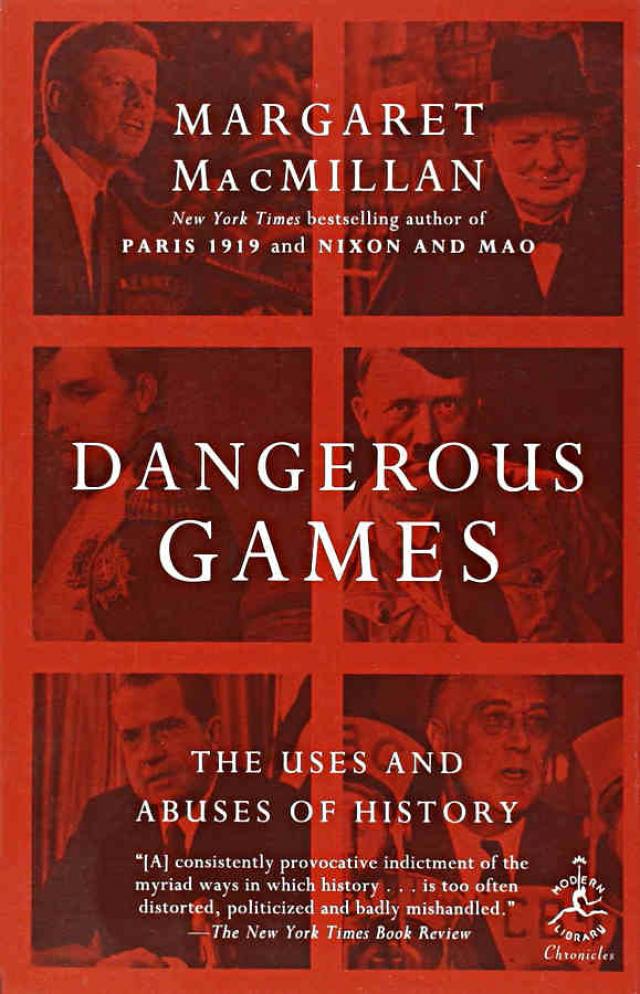
Dangerous Games: The Uses and Abuses of History
Margaret MacMillan
Margaret MacMillan
Acclaimed historian Margaret MacMillan explores here the many ways in which history affects us all. She shows how a deeper engagement with history, both as individuals and in the sphere of public debate, can help us understand ourselves and the world better. But she also warns that history can be misused and lead to misunderstanding. History is used to justify religious movements and political campaigns alike. Dictators may suppress history because it undermines their ideas, agendas, or claims to absolute authority. Nationalists may tell false, one-sided, or misleading stories about the past. Political leaders might mobilize their people by telling lies. It is imperative that we have an understanding of the past and avoid these and other common traps in thinking to which many fall prey. This brilliantly reasoned work, alive with incident and figures both great and infamous, will compel us to examine history anew—and skillfully illuminates why it is important to treat the past with care.From Publishers WeeklyMacMillan, author of the acclaimed Paris 1919, reminds readers that history matters: It is particularly unfortunate that just as history is becoming more important in our public discussions, professional historians have largely been abandoning the field to amateurs. According to MacMillan, this is a grave mistake. Governments and leaders use history to invent tradition and subvert the past. In a world hungry for heroes, badly researched historical biographies fly off bookstore shelves. In this highly readable and polished book, readers learn of the dangers of not properly tending to the past, of distorting it and ignoring inconvenient facts. If done correctly, history helps unlock the past in useful ways. The author explores the ways history has present meaning—not always constructively: in providing a sense of identity for groups, as a basis of nationalism or national pride, as a tool for redress of past wrongs and as an ideological tool. In this important work, we learn that history is more than presenting facts, it is about framing the past. This is a must read for anyone who wants to understand the importance of correctly understanding the past.From Bookmarks MagazineIn this compelling, persuasive treatise, MacMillan investigates the innumerable ways that history has been twisted, embellished, and politicized to serve one purpose or another throughout, well, history. Based on a series of lectures delivered at the University of Western Ontario, Dangerous Games details MacMillan's expert analyses and arguments, presented in her incisive, witty prose. Critics praised MacMillan's reasoning, even if they did not always agree with her proposed solutions. For example, her appeal to leave history to the "professional historians" rankled the critics who believe that amateurs add energy and relevance to the field. Others pointed out that professionals are not without their own biases. Despite these complaints, MacMillan's balanced defense of the importance of the study of history is eloquent and timely.
Read online